
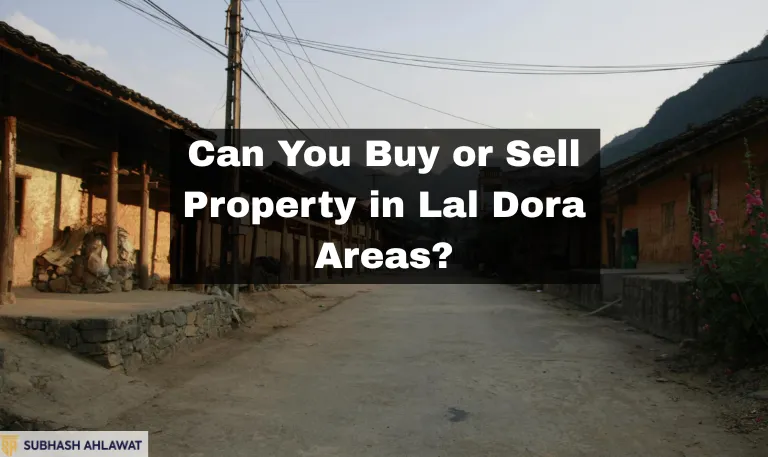
The question whether property situated in Lal Dora areas can be legally bought or sold frequently arises in North India, particularly in villages falling within urbanized regions of Delhi, Haryana, and parts of Punjab. With rapid urban expansion and increasing demand for affordable land, transactions in Lal Dora properties have significantly increased. However, such transactions are accompanied by unique legal considerations.
Meaning and Historical Background of Lal Dora
The term Lal Dora traces its origin to the British colonial period. Around 1908, the British administration demarcated certain portions of village habitation areas with a red line on revenue maps. These red-marked zones were called “Lal Dora” (literally meaning “red thread”).
Lal Dora areas typically comprise:
Residential houses within village abadi
Village pathways
Small commercial establishments
Structures constructed without formal building plans
Historically, these areas were exempted from certain building regulations and municipal laws. The intention was to allow villagers flexibility in constructing dwelling units without rigid urban planning norms.
Legal Nature of Lal Dora Property
1. Revenue Classification
Lal Dora land generally forms part of the abadi deh (village habitation land). Such land is often recorded in revenue records but may not always have clear individual ownership entries in the same manner as agricultural land.
2. Urbanization and Municipal Control
With the expansion of cities like Delhi and the development of NCR regions, many villages were urbanized. Once urbanized, municipal laws may gradually apply; however, the internal structures in Lal Dora areas often remain outside strict building by-laws unless specifically notified.
Can You Legally Buy Property in Lal Dora Areas?
A. Legality of Purchase
Yes, property in Lal Dora areas can be bought and sold. There is no statutory prohibition against transfer of such property. However, the nature of documentation and verification differs from regular urban plotted properties.
Ownership is typically transferred through:
Registered Sale Deed
GPA (General Power of Attorney) transactions (though legally discouraged after judicial scrutiny)
Will-based transfers
Relinquishment or family settlement deeds
After the judgment of the Supreme Court in Suraj Lamp & Industries Pvt. Ltd. v. State of Haryana, GPA sales without registered conveyance do not convey legal title. Therefore, proper registered sale deeds are essential.
B. Essential Documents to Verify Before Purchase
A prudent purchaser must verify:
Lal Dora Certificate – Issued by the revenue authority confirming the property falls within Lal Dora limits.
Revenue Records – Such as jamabandi or khasra entries.
Chain of Title – Previous sale deeds or ownership documents.
Possession and Physical Verification – To avoid encroachment disputes.
Encumbrance Certificate – To check pending liabilities.
Unlike regular DDA or HUDA plots, Lal Dora properties may not have sanctioned building plans or completion certificates.
Can You Sell Property in Lal Dora Areas?
Yes, owners can legally sell property situated in Lal Dora areas, subject to:
Clear and marketable title
Absence of litigation
Proper registration of sale deed
Compliance with stamp duty requirements
The seller must ensure that:
The property is not subject to acquisition proceedings.
There are no disputes regarding common village pathways.
There are no claims from co-sharers or family members.
Registration and Stamp Duty
Under the Registration Act, 1908, sale deeds of immovable property exceeding Rs. 100 must be registered. The same applies to Lal Dora properties.
Stamp duty is calculated on circle rate or transaction value, whichever is higher. In Delhi, circle rates for Lal Dora properties may differ from regular colonies.
Are Building Plans Required in Lal Dora Areas?
Traditionally, construction within Lal Dora did not require sanctioned building plans. However, with urbanization:
Municipal authorities may require compliance in certain cases.
Commercial usage may attract licensing requirements.
Illegal or hazardous construction can be subject to demolition.
Buyers must verify current municipal notifications applicable to the specific village.
Common Legal Risks in Lal Dora Transactions
1. Title Disputes: Because many properties were transferred informally over decades, documentation gaps are common.
2. Multiple Claims: Family settlements without registration often lead to competing ownership claims.
3. Acquisition Risk: Government agencies may acquire village lands for infrastructure projects.
4. Financing Limitations: Banks often hesitate to grant housing loans on Lal Dora properties due to unclear title and lack of approved building plans.
5. Unauthorized Construction: Even if construction was historically exempt, unsafe or commercial misuse may invite municipal action.
Judicial Approach
Courts in India have consistently held that:
Transfer of immovable property must comply with statutory requirements.
Mere possession does not confer ownership without valid title.
Revenue entries are not conclusive proof of ownership but carry evidentiary value.
The decision in Suraj Lamp & Industries Pvt. Ltd. v. State of Haryana clarified that GPA sales do not constitute legal conveyance of ownership.
Thus, while Lal Dora properties are transferable, transactions must strictly comply with property and registration laws.
Difference Between Lal Dora and Extended Lal Dora
Extended Lal Dora refers to land adjoining original abadi areas that was later included for habitation expansion. Legal complications are greater in extended areas because:
Original demarcation may be unclear.
Revenue classification may differ.
Agricultural land conversion issues may arise.
Purchasers must exercise heightened due diligence.
Due Diligence Checklist for Buyers
Before finalizing purchase, a buyer should:
Conduct title search for at least 20–30 years.
Verify that the seller has undisputed possession.
Obtain indemnity from seller against prior claims.
Confirm land use status.
Ensure registration of sale deed.
Check municipal applicability post-urbanization.
Professional legal assistance is strongly recommended to avoid future litigation. Parties dealing with Lal Dora property matters may seek proper legal guidance from experienced professionals such as Advocate Subhash Ahlawat, who practices in property and civil litigation matters.
Practical Considerations
Advantages
Lower price compared to planned colonies
Flexible construction norms (subject to current law)
Suitable for self-occupation
Disadvantages
Higher litigation risk
Loan difficulties
Infrastructure limitations
Title irregularities
Frequently Asked Questions
1. Is registry possible in Lal Dora property?
Yes, registry is legally permissible through a registered sale deed.
2. Can banks provide loans?
Some banks may provide loans, but many remain cautious due to title concerns.
3. Is mutation required?
Yes, mutation in revenue records strengthens possessory rights but does not create title.
4. Is construction fully free from regulation?
Not entirely. Urbanization notifications may impose certain municipal requirements.
Conclusion
Property situated within Lal Dora areas can indeed be legally bought and sold. However, such transactions demand enhanced scrutiny compared to regular urban plotted developments. The absence of standardized layouts, historical informal transfers, and evolving municipal regulations make due diligence indispensable.
The legality of transfer primarily depends upon:
Valid and registered sale deed
Clear chain of title
Absence of encumbrances
Compliance with statutory provisions
While Lal Dora properties present affordable investment opportunities, they carry proportionately higher legal risks. Therefore, parties must undertake comprehensive legal verification prior to executing any transaction.
In conclusion, buying or selling property in Lal Dora areas is legally permissible, but prudence, documentation, and professional legal guidance are essential to safeguard one’s proprietary rights and avoid protracted litigation.
A note on this article — This is general information about the law as understood at the time of writing, and not legal advice. The position should be verified against the provisions in force at the relevant time. For advice on a specific matter, please consult an advocate.
Subhash Ahlawat
Advocate · Faridabad & Delhi NCR
Enrolled with Bar Council of Punjab & Haryana
An advocate practising in Faridabad and the Delhi NCR since 2003, across criminal, civil, property, family and commercial matters.