
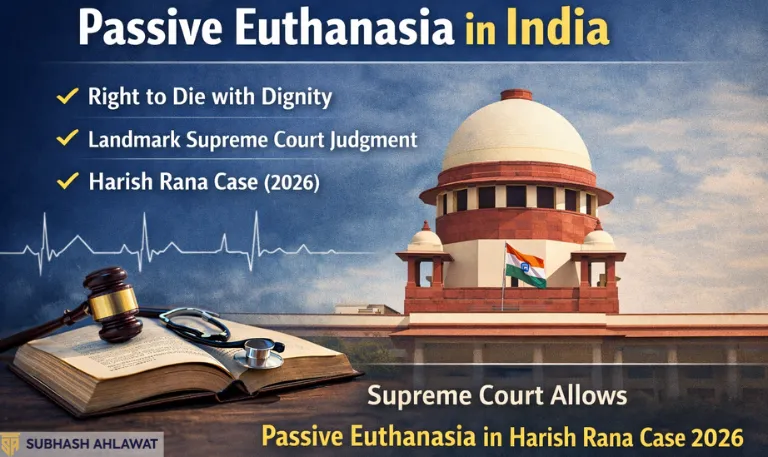
The issue of euthanasia has long been one of the most debated topics in constitutional law, medical ethics, and human rights. It raises an important question: Should a person suffering from an irreversible medical condition have the right to die with dignity when medical treatment only prolongs suffering or an unconscious existence?
In India, euthanasia has primarily developed through judicial decisions rather than legislation. While active euthanasia remains illegal, the Supreme Court of India has recognised passive euthanasia under specific safeguards.
The law relating to passive euthanasia evolved through landmark judgments such as Aruna Shanbaug v. Union of India (2011) and Common Cause v. Union of India (2018). Recently, the Supreme Court delivered a historic judgment on 11 March 2026 in the Harish Rana case, allowing withdrawal of life-sustaining treatment and marking the first practical implementation of passive euthanasia by the Court in India.
What is Euthanasia?
Euthanasia refers to intentionally ending a person's life to relieve suffering caused by severe illness or medical conditions. In legal and medical discussions, euthanasia is broadly classified into two categories.
Active Euthanasia
Active euthanasia involves direct action to cause a person’s death, such as administering a lethal injection or medication.
Under Indian law, active euthanasia is illegal and may attract criminal liability under provisions of the Indian Penal Code relating to culpable homicide or abetment of suicide.
Passive Euthanasia
Passive euthanasia refers to withdrawing or withholding medical treatment necessary to sustain life, allowing the patient to die naturally.
Examples include:
Withdrawal of ventilator support
Stopping artificial nutrition or feeding tubes
Discontinuation of life-sustaining medicines or treatment
Unlike active euthanasia, passive euthanasia does not directly cause death but allows the underlying medical condition to take its natural course.
The Supreme Court has permitted passive euthanasia under strict legal safeguards.
Constitutional Basis: Right to Die with Dignity
The recognition of passive euthanasia in India is rooted in Article 21 of the Constitution of India, which guarantees the Right to Life and Personal Liberty.
Over the years, the Supreme Court has interpreted Article 21 broadly to include:
Right to live with dignity
Right to privacy
Right to personal autonomy
The Court has held that human dignity must extend even to the final stage of life.
In the landmark Common Cause judgment (2018), the Supreme Court ruled that the right to die with dignity is a part of the Right to Life under Article 21. The Court also recognized the legality of Living Wills or Advance Directives, allowing individuals to express their wishes regarding medical treatment if they become incapable of making decisions in the future.
Thus, the constitutional foundation of passive euthanasia lies in the principles of dignity, autonomy, and bodily integrity.
Evolution of Passive Euthanasia Law in India
The law relating to passive euthanasia in India has evolved gradually through several important Supreme Court judgments.
1. Aruna Shanbaug v. Union of India (2011)
The first major case dealing with euthanasia in India was the Aruna Shanbaug case.
Aruna Shanbaug was a nurse who remained in a persistent vegetative state for more than 40 years after being brutally assaulted in 1973.
A petition was filed before the Supreme Court seeking permission for euthanasia. While the Court ultimately refused to allow euthanasia in her case, it recognized passive euthanasia as legally permissible under certain circumstances.
The Court laid down important guidelines:
Withdrawal of life support could be allowed in appropriate cases
The decision required approval from the High Court concerned
Medical experts must confirm the patient’s condition
This judgment became the first legal recognition of passive euthanasia in India.
2. Common Cause v. Union of India (2018)
The legal position was further clarified by a Constitution Bench of the Supreme Court in 2018.
In this case, the Court recognized two major principles:
Right to Die with Dignity
The Court held that the right to die with dignity forms part of Article 21 of the Constitution.
Recognition of Living Wills
The Court also legalized Living Wills (Advance Directives). A living will allows a person to state in advance that if they become terminally ill or permanently unconscious, they do not wish to receive life-sustaining treatment.
The judgment also introduced procedural safeguards, including the requirement of medical boards to examine the patient’s condition before withdrawal of treatment.
3. Modification of Guidelines in 2023
In January 2023, the Supreme Court simplified the earlier guidelines to make the procedure more practical.
The Court made several improvements:
Simplified execution of living wills
Reduced bureaucratic formalities
Made the medical board process easier
These modifications were intended to ensure that the right recognized by the Court could be effectively implemented in real situations.
The Harish Rana Case (2026): A Historic Judgment
A major milestone in the development of euthanasia law in India came with the Supreme Court judgment dated 11 March 2026 in the case of Harish Rana.
This case is widely regarded as India’s first instance where passive euthanasia was actually permitted by the Supreme Court.
Facts of the Case
Harish Rana was a young man who suffered severe brain injuries after falling from a building in 2013 while he was a student.
As a result of the accident, he entered a persistent vegetative state. For more than 13 years, he remained completely dependent on medical support, including artificial feeding.
Medical experts confirmed that:
His condition was irreversible
There was no realistic chance of recovery
He lacked consciousness and cognitive awareness
His parents eventually approached the Court seeking permission to withdraw life-sustaining treatment, arguing that continuing treatment only prolonged biological existence without dignity.
Proceedings Before the Supreme Court
The Supreme Court followed the medical board procedure established in earlier judgments.
Two medical boards were constituted:
Primary Medical Board
Secondary Medical Board
Both boards examined the patient’s medical condition and concluded that:
Harish Rana was in a permanent vegetative state
Recovery was medically impossible
Continuing treatment served no therapeutic purpose
Supreme Court Decision (11 March 2026)
After considering the medical reports and the family's request, the Supreme Court allowed the withdrawal of life-sustaining treatment.
The Court held that continuing treatment in such circumstances would not serve the purpose of preserving meaningful life, and therefore passive euthanasia could be permitted.
The Court also directed that the withdrawal of treatment must be carried out in a humane and dignified manner.
Importantly, the Court clarified that terminal illness is not a necessary condition for passive euthanasia. Patients who are permanently unconscious with no possibility of recovery may also fall within the scope of the legal framework.
Significance of the Harish Rana Judgment
The Harish Rana case is considered a landmark for several reasons.
First Practical Implementation
Although passive euthanasia had been legally recognized since 2011, this was the first case where the Supreme Court actually allowed withdrawal of life support.
Reinforcement of Constitutional Principles
The judgment reaffirmed that the right to life includes the right to die with dignity.
Clarification of Legal Procedure
The decision strengthened the medical board mechanism and clarified how passive euthanasia should be implemented in practice.
Expansion Beyond Terminal Illness
The Court clarified that passive euthanasia can apply even when a patient is not terminally ill but permanently unconscious.
Safeguards for Passive Euthanasia in India
To prevent misuse, the Supreme Court has laid down strict safeguards.
Living Will or Advance Directive: Individuals can execute a living will, expressing their wish regarding medical treatment if they become incapable of making decisions.
Medical Boards: Two medical boards must examine the patient before withdrawal of treatment is allowed.
Consent of Family Members: The patient’s relatives or legal guardians must be consulted before a final decision is taken.
Documentation and Transparency: All decisions must be carefully documented to prevent abuse or coercion.
These safeguards aim to balance patient autonomy with protection against misuse.
Need for a Comprehensive Law
Currently, passive euthanasia in India is governed primarily by Supreme Court guidelines rather than a dedicated statute.
Many legal experts believe that Parliament should enact a comprehensive euthanasia law to provide clarity regarding:
Medical procedures
Legal protections for doctors
Regulation of living wills
Safeguards against misuse
A statutory framework would ensure uniform implementation across the country.
Conclusion
Passive euthanasia in India represents a careful balance between the sanctity of life and the dignity of death. Through a series of landmark judgments—Aruna Shanbaug (2011), Common Cause (2018), and the Harish Rana decision (2026)—the Supreme Court has gradually shaped the legal framework governing end-of-life decisions.
The Harish Rana judgment of 11 March 2026 stands as a historic milestone, demonstrating the practical application of the doctrine of passive euthanasia in India. It reinforces the principle that the right to life under Article 21 includes the right to live and die with dignity.
However, the absence of a dedicated law still leaves several legal and procedural questions unresolved. Until Parliament enacts comprehensive legislation, the framework developed by the Supreme Court will continue to guide courts, doctors, and families dealing with complex end-of-life decisions.
A note on this article — This is general information about the law as understood at the time of writing, and not legal advice. The position should be verified against the provisions in force at the relevant time. For advice on a specific matter, please consult an advocate.
Subhash Ahlawat
Advocate · Faridabad & Delhi NCR
Enrolled with Bar Council of Punjab & Haryana
An advocate practising in Faridabad and the Delhi NCR since 2003, across criminal, civil, property, family and commercial matters.