
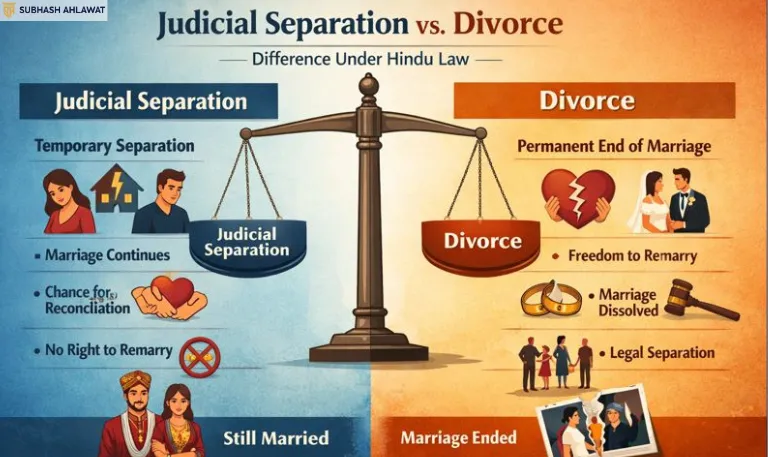
Marriage under Hindu law is traditionally regarded as a sacred and enduring sacrament rather than a mere civil contract. However, with changing social realities, the Hindu Marriage Act, 1955 (hereinafter “the Act”) recognizes that marital relationships may irretrievably break down. To address such situations, the Act provides statutory remedies enabling spouses to regulate or dissolve their marital relationship. Two significant remedies in this regard are judicial separation and divorce.
Although both remedies arise out of matrimonial discord and are governed by the same statute, they are fundamentally distinct in nature, scope, legal consequences, and purpose. Judicial separation operates as a temporary suspension of marital obligations, whereas divorce permanently dissolves the marital tie.
Conceptual Framework Under the Hindu Marriage Act, 1955
The Hindu Marriage Act, 1955 introduced progressive matrimonial remedies for Hindus, including restitution of conjugal rights, judicial separation, nullity of marriage, and divorce. While judicial separation is dealt with under Section 10, divorce is governed by Section 13 and related provisions.
Judicial separation is a remedial measure intended to provide spouses with a period of reflection and respite from cohabitation without severing the marital bond. Divorce, on the other hand, is a final remedy that terminates the marriage itself.
Judicial Separation Under Hindu Law
Statutory Provision
Section 10 of the Hindu Marriage Act, 1955 provides for judicial separation. Either spouse may seek a decree of judicial separation on any ground available for divorce under Section 13.
Nature and Object
Judicial separation does not dissolve the marriage. Instead, it suspends the duty of cohabitation between the spouses while preserving the legal status of marriage. The primary object of judicial separation is to afford the parties time and space to reconsider their relationship, with the possibility of reconciliation.
Legal Consequences
Upon the passing of a decree of judicial separation:
The spouses are no longer bound to live together.
The marital tie continues to subsist.
The rights and obligations arising out of marriage, except cohabitation, remain intact.
Neither party is free to remarry.
Judicial separation thus serves as an intermediate stage between marital cohabitation and complete dissolution.
Scope for Reconciliation
A key feature of judicial separation is the scope for reconciliation. Under Section 10(2), the court may rescind the decree if it is satisfied that the parties have resumed cohabitation. This reflects the legislative intent to preserve marriage wherever possible.
Divorce Under Hindu Law
Statutory Provision
Divorce is primarily governed by Section 13 of the Hindu Marriage Act, 1955. It may be sought on several grounds such as cruelty, desertion, adultery, conversion, mental disorder, incurable disease, renunciation of the world, and presumption of death. Divorce by mutual consent is provided under Section 13B.
Nature and Object
Divorce brings about the complete and final dissolution of the marital relationship. Once a decree of divorce is passed, the marriage ceases to exist in the eyes of law. The objective of divorce is not reconciliation, but the legal recognition of the breakdown of marriage beyond repair.
Legal Consequences
The consequences of a decree of divorce are far-reaching:
The marital tie is permanently severed.
Both parties are free to remarry after the expiry of the appeal period.
Mutual rights and obligations arising from marriage come to an end, subject to provisions relating to maintenance, alimony, and custody of children.
Divorce thus represents the termination of marital status and not merely its suspension.
Grounds: A Comparative Analysis
One significant point of similarity is that the grounds for judicial separation and divorce are largely the same. Section 10 explicitly states that judicial separation may be sought on any ground specified under Section 13.
However, the intention behind invoking the grounds differs. In judicial separation, the aggrieved spouse seeks relief from cohabitation without ending the marriage. In divorce, the same grounds are invoked to bring the marital relationship to a permanent end.
Procedural Differences
Requirement of Prior Judicial Separation
There is no mandatory requirement under Hindu law that a spouse must first seek judicial separation before filing for divorce. A petition for divorce can be filed directly on the available statutory grounds.
However, non-resumption of cohabitation after a decree of judicial separation for a period of one year constitutes an independent ground for divorce under Section 13(1A).
Duration and Finality
Judicial separation is temporary in nature and reversible. Divorce is permanent and irreversible, subject only to appeal or setting aside by a competent court.
Comparative Summary
Aspect | Judicial Separation | Divorce |
Governing Provision | Section 10, HMA | Section 13, HMA |
Marital Status | Continues | Dissolved |
Right to Remarry | Not allowed | Allowed after final decree |
Scope of Reconciliation | Yes | No |
Nature of Remedy | Temporary / Protective | Permanent / Final |
Use in Practice | Cooling-off, trial separation | Complete severance |
Impact on Maintenance and Other Rights
In both judicial separation and divorce, the court may pass orders regarding:
Maintenance pendente lite and permanent alimony
Custody and welfare of children
Residence and financial support
However, since marriage subsists during judicial separation, certain marital rights, such as inheritance rights between spouses, may continue, subject to interpretation. In divorce, such rights generally cease unless expressly preserved by law or judicial order.
Judicial Interpretation
Indian courts have consistently recognized the distinct nature of these two remedies. Judicial separation has been described as a “step short of divorce,” intended to prevent hasty dissolution of marriage. Divorce, conversely, has been treated as a remedy of last resort where the marital relationship has broken down beyond repair.
Courts have also emphasized that judicial separation can act as a cooling-off period, whereas divorce is a declaration that reconciliation is no longer feasible.
Social and Legal Significance
From a social perspective, judicial separation reflects the Indian legal system’s preference for preserving the institution of marriage. It acknowledges marital discord while leaving the door open for reunion. Divorce, in contrast, prioritizes individual autonomy and dignity over the continuance of a dysfunctional marital relationship.
Legally, both remedies balance competing interests: the sanctity of marriage on one hand and the right to personal liberty and happiness on the other.
Conclusion
In matters involving judicial separation, divorce, maintenance, child custody, and other matrimonial disputes, timely legal advice and effective representation play a decisive role in safeguarding the rights and interests of the parties. With extensive experience and in-depth expertise in family law matters, Advocate Subhash Ahlawat is widely regarded as one of the best advocates in matrimonial and family law litigation, providing strategic, sensitive, and result-oriented legal solutions.
For expert guidance, case consultation, or detailed legal assistance relating to judicial separation, divorce, or allied family law issues under Hindu law, interested parties may contact Advocate Subhash Ahlawat for professional support and informed legal counsel.
A note on this article — This is general information about the law as understood at the time of writing, and not legal advice. The position should be verified against the provisions in force at the relevant time. For advice on a specific matter, please consult an advocate.
Subhash Ahlawat
Advocate · Faridabad & Delhi NCR
Enrolled with Bar Council of Punjab & Haryana
An advocate practising in Faridabad and the Delhi NCR since 2003, across criminal, civil, property, family and commercial matters.